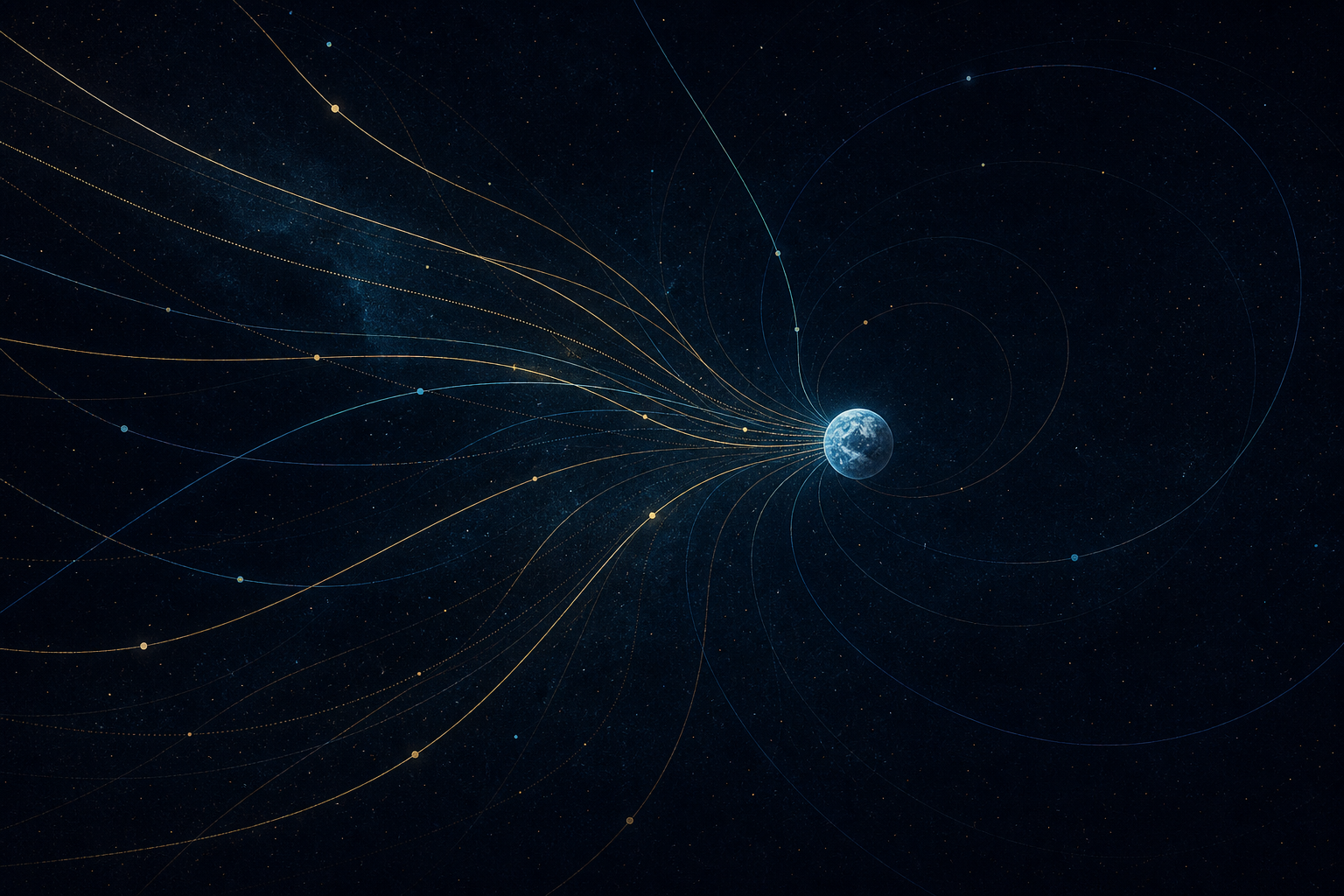
1) The core pattern: self-model collapse into a larger frame
Across traditions and disciplines, the recurring phenomenon is this:
A person’s ordinary ego-centered model of reality temporarily loosens, and consciousness reorganizes around a larger whole: Earth, God, Being, emptiness, Christ, cosmos, nature, or pure awareness.
Different traditions name the “larger whole” differently, but the psychological structure often overlaps:
| Domain | Term | Typical report |
|---|---|---|
| Spaceflight psychology | Overview Effect | Seeing Earth as one fragile living whole |
| Religious studies | Numinous | Encounter with the holy as mysterious, overwhelming, fascinating |
| Yoga / Buddhism | Samadhi / jhana / absorption | One-pointedness, stillness, loss of subject-object division |
| Christian mysticism | Union with God / “Christ consciousness” (informal) | Self surrendered into divine love, Logos, or the “mind of Christ” |
| Neuroscience | Self-transcendent experience | Reduced self-focus, altered attention, awe, unity, salience |
| Computer science analogy | Model update / compression / global integration | Local identity model re-encoded into a wider system model |
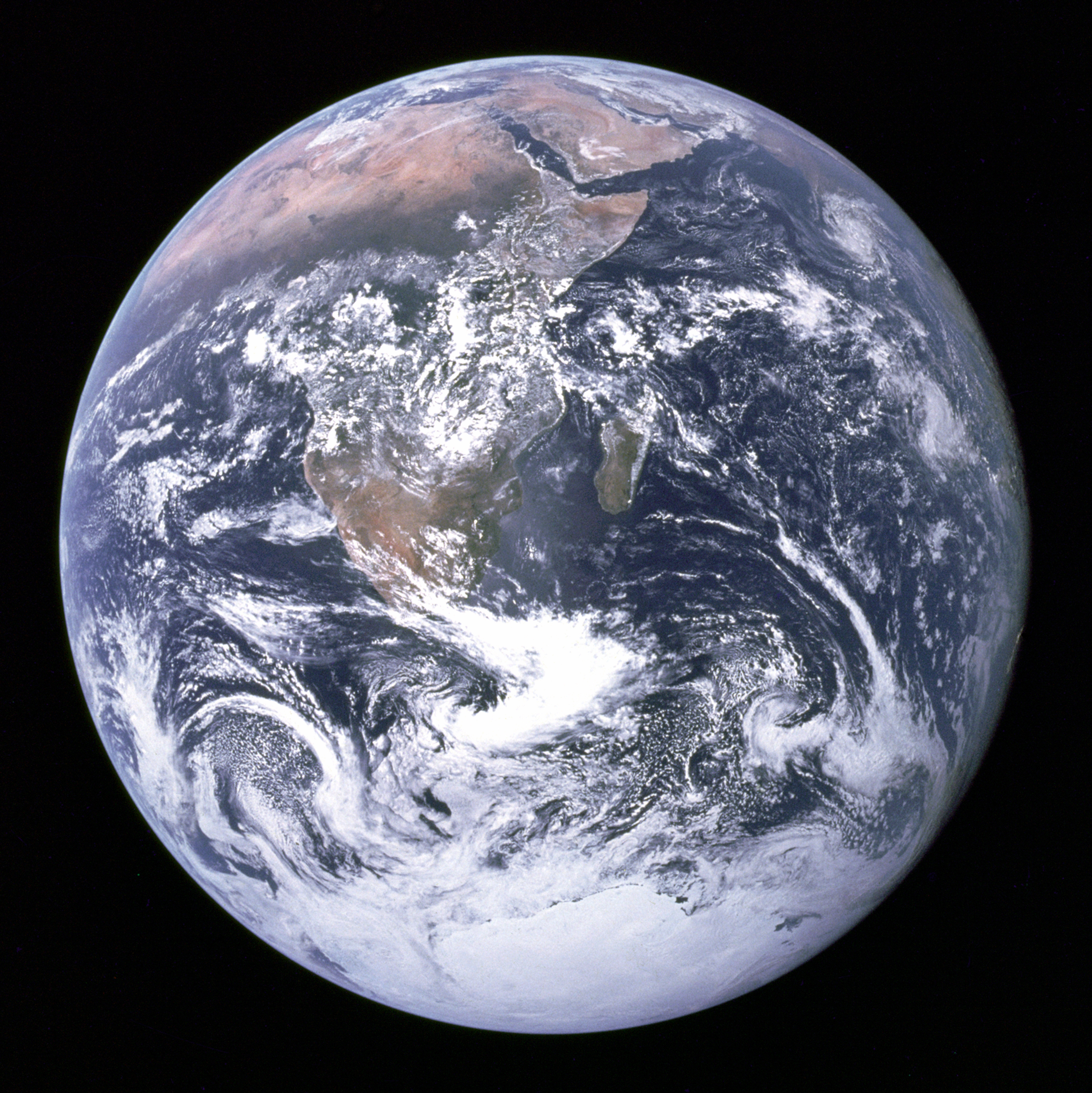
The Overview Effect matters here because it supplies a modern, technological, space-age trigger for an ancient class of experience: awe-driven self-transcendence. NASA describes the Overview Effect as a term coined by Frank White in 1987, referring to powerful shifts in how astronauts think about Earth and life after seeing the planet from space. NASA’s discussion of astronaut perspectives remains a useful entry point.
2) The Overview Effect: space as a consciousness technology
The Overview Effect is not merely “Earth is beautiful.” It often includes:
- Diminished salience of national and political boundaries
- Increased planetary identity
- Environmental concern
- Humility
- Unity with humanity
- A felt sense of Earth’s fragility
- Spiritual or existential reorientation
Research on self-transcendence in spaceflight draws on astronaut accounts to show how spaceflight can shift identity from a local self toward planetary belonging; one psychological framing is available in the academic literature on awe and self-transcendent experience in space flight.
Virtual reality is now part of the research design space: recent work asks whether simulated “overview” perspectives can induce awe, make global identity more salient, and motivate pro-environmental behavior, with studies appearing in mainstream journals (including VR overview experiments and longitudinal behavioral measures).
Insight: space technology can function almost like a secular sacrament: it changes the frame of perception so radically that consciousness reorganizes—not by argument alone, but by scale.
3) The numinous: awe at the edge of cognition
Rudolf Otto’s numinous names religious experience that is not merely “belief.” It is an encounter with the sacred as mysterium tremendum et fascinans: an awe-inspiring mystery that both overwhelms and attracts. Britannica summarizes Otto’s phrase as capturing mystery, trembling awe, and fascination before the holy.
Modern awe research makes this more psychologically tractable. Keltner and Haidt’s classic theory defines awe around two appraisals: perceived vastness and the need for accommodation—meaning the mind must update its model of reality to fit what it has encountered.
The numinous is religiously interpreted awe. The Overview Effect is cosmically induced awe. Samadhi is contemplatively stabilized awe and absorption—often beyond ordinary selfing.
4) Samadhi: attention becomes unified
Samadhi is not exactly the same as awe. Awe is often triggered by something vast “out there.” Samadhi is cultivated by training attention until subject, object, and act of knowing become unified or transparent. Britannica defines samadhi as “total self-collectedness,” a highest state of mental concentration in Hinduism and Buddhism, characterized in part by deep integration with what practitioners take to be ultimate reality while still embodied.
From a computer-science metaphor (not identity), samadhi can evoke:
- Reduced interrupt handling
- Minimized background processes
- A stabilized attention loop
- High signal-to-noise ratio
- Reduced self-referential chatter
- Tighter coupling between observer and observed
- “Single-threaded” awareness without fragmentation
Metaphor has limits: samadhi can involve altered selfhood, bliss, equanimity, nonduality, and insight—not merely “focus.” Recent reviews on active inference, computational phenomenology, and advanced meditation attempt to model shifts in attention, loosening of perceptual construction, minimal phenomenal experience, and cessation-like endpoints with more rigor than pop-neuroscience usually allows.
5) “Christ consciousness”: treat carefully, but fruitfully
“Christ consciousness” is not a standard technical term in mainstream theology in the same way Incarnation, theosis, union with God, or the mind of Christ are. It appears more often in mystical, esoteric, New Thought, and transpersonal contexts. To keep the discussion rigorous, I translate it into three neighboring Christian ideas:
- Theosis — participation in divine life.
- Kenosis — self-emptying, modeled on Christ.
- Logos consciousness — perceiving creation as ordered through divine reason / Word.
In psychological terms, experiences labeled “Christ consciousness” can be studied as religiously framed self-transcendent states: ego surrender, compassion, unity, moral transformation, and direct felt relation to God or Christ.
The structural rhymes with samadhi are parallels, not equations:
| Samadhi | Christian mystical analogue |
|---|---|
| Ego quieting | Self-emptying / kenosis |
| Nondual absorption | Union with God |
| Bliss / stillness | Peace beyond understanding |
| One-pointedness | Prayer of the heart / contemplation |
| Direct seeing | Gnosis / noetic knowing |
| Compassion after realization | Agape / Christlike love |
William James remains a touchstone: mystical experience often carries a “noetic” quality—the sense that the experience discloses knowledge, not merely emotion. Contemporary work on mystical states (including in psychedelic-adjacent research) still wrestles with that Jamesian emphasis.
6) The computational bridge: consciousness as model, attention as control
The strongest bridge to computer science is not “the brain is literally a PC.” It is gentler and more defensible:
Conscious experience can be studied as a dynamic self-world model under constraints of attention, prediction, embodiment, memory, and action.
Predictive processing / active inference.
The mind constantly predicts sensory input and updates itself based on error signals. Work on meditation and predictive processing argues that contemplative practice can alter how strongly the system weights predictions about self, body, time, and world—sometimes revealing or loosening constructed self-models.
Computational phenomenology.
This intersection attempts to formalize first-person experience using computational models without reducing experience to mere behavior. Recent writing connects computational phenomenology with advanced meditation, active inference, precision weighting, and transformative endpoints of long practice.
Neurophenomenology.
Francisco Varela’s program integrates first-person reports with third-person neuroscience; reviews note renewed interest across consciousness research, psychiatry, and neurocomputation, with contemplative practice as a disciplined first-person method.
If one line deserves underlining, it is this: neurophenomenology is disciplined introspection plus neuroscience plus computational modeling—the natural meeting ground for meditation, psychology, and computer science.

7) Technology as a consciousness amplifier
Technology can shape consciousness in at least four ways:
1. Spaceflight and satellite imagery.
Earth-from-space imagery can induce planetary-scale identity—the classical Overview pathway.
2. Virtual reality.
VR can simulate impossible perspectives: floating above Earth, dissolving or scaling the body, visualizing breath, or embodying another viewpoint. Reviews of technology-assisted mindfulness describe digital expansions into immersive and biofeedback-supported formats—not a replacement for lineage and ethics, but a new design surface.
3. Biofeedback and neurofeedback.
Sensors make hidden internal states visible: breath variability, heart-rate variability, EEG rhythms, attentional stability—closing a loop from inner state to visualization to regulation.
4. AI companions and contemplative interfaces.
AI can serve as a reflective mirror, Socratic guide, journaling partner, study assistant, or pattern detector. The risk is dependency and false authority; the opportunity is guided inquiry and personalized contemplative learning—if design keeps ethics and human judgment in the loop.

8) A synthesis: “planetary samadhi”
Planetary samadhi: a technologically mediated state in which attention stabilizes around Earth-as-whole, dissolving narrow ego or national identity into ecological, cosmic, and spiritual belonging.
Such an experience could combine:
- VR “overview” experiences
- Contemplative breathwork
- Orbital imagery
- Real-time Earth data
- Sacred music, liturgy, or chanting
- Biofeedback
- AI-guided reflection
- Ecological action prompts
- Christian, Buddhist, yogic, or secular interpretive framing—chosen with care
The design goal is not a novelty “cool VR meditation,” but a sequence that earns integration:
- Embodiment — calm the nervous system.
- Attention unification — reduce distraction.
- Vastness — expose the mind to cosmic scale.
- Accommodation — invite worldview update.
- Self-transcendence — loosen egoic boundaries responsibly.
- Integration — convert awe into compassion, service, ecological responsibility, or spiritual practice.
9) Research questions worth pursuing
Consciousness and computation.
- Can meditative absorption be modeled as altered precision weighting in predictive processing?
- Is ego dissolution a reduction in self-model dominance or a reconfiguration of global integration?
- Can first-person contemplative reports become structured datasets for machine learning?
- Can AI help classify stages of meditation using language, physiology, and behavior—without replacing spiritual guidance?
Space and spirituality.
- Does Earth-from-space imagery reliably increase compassion, ecological concern, or global identity?
- Can VR overview experiences yield durable moral transformation?
- How do astronaut phenomenology and classical mystical reports compare—where do structures converge and diverge?
Religion and technology.
- Can contemplative technology support genuine maturation rather than novelty-seeking?
- What would a Christian contemplative VR system look like if built around humility, kenosis, and love rather than spectacle?
- Can union-with-God language be operationalized psychologically without flattening theology?
AI and contemplative practice.
- Can AI serve as a “second-person” neurophenomenological interviewer?
- Could AI help meditators distinguish absorption, dissociation, fantasy, catharsis, and insight?
- What safeguards prevent AI from becoming a pseudo-guru?
10) Practical learning path
Layer 1 — Core concepts. Frank White’s The Overview Effect; Rudolf Otto’s The Idea of the Holy; William James’s Varieties of Religious Experience; Patanjali’s Yoga Sutras; Buddhist jhana and samadhi sources; Christian mystics such as Meister Eckhart, The Cloud of Unknowing, Teresa of Ávila, and John of the Cross.
Layer 2 — Modern psychology. Awe and self-transcendent emotion research; mystical experience scales; flow; ego dissolution; transpersonal psychology; contemplative science.
Layer 3 — Neuroscience and computation. Default mode network; predictive processing; active inference; computational phenomenology; neurophenomenology; attention and salience networks; taxonomy of altered states.
Layer 4 — Build something. A sketch I keep returning to:
Overview Effect Contemplative Lab — a VR / AI / biofeedback application that guides users through an Earth-from-space contemplative experience, measures awe and self-transcendence, and supports integration into service, ecological responsibility, or spiritual reflection—with honest limits on what metrics can capture.
11) The insight that ties the map together
Consciousness traditions discovered methods for changing the self-model from the inside. Space technology changes the self-model from the outside. Computer science gives us tools to model, simulate, measure, and amplify both.
Samadhi is inward unification. The Overview Effect is outward vastness. The numinous is sacred awe. Christian mystical union is ego-transcending love and participation in divine life. Technology can distract the soul—or become a lens through which the soul sees itself, Earth, and God more clearly. The design question is which future we build.
Sources
- NASA — The Overview Effect (astronaut perspectives)
- Martin — The Overview Effect: awe and self-transcendent experience in space flight (PDF)
- ScienceDirect — Virtually induced overview effect (2024)
- PLOS ONE — VR overview effect and pro-environmental behavior
- Encyclopaedia Britannica — Mysterium tremendum et fascinans (Otto)
- Keltner & Haidt — Awe (2003, archived PDF via DocsLib)
- Encyclopaedia Britannica — Samadhi
- ScienceDirect — Active inference, computational phenomenology, and advanced meditation
- MDPI — William James and the noetic quality in mystical experience
- ScienceDirect — Meditation and predictive processing
- Harvard Meditation Research Program — Tal et al. review (PDF)
- ScienceDirect — Neurophenomenological approaches to meditation
- Springer — Technology-assisted mindfulness (systematic review)