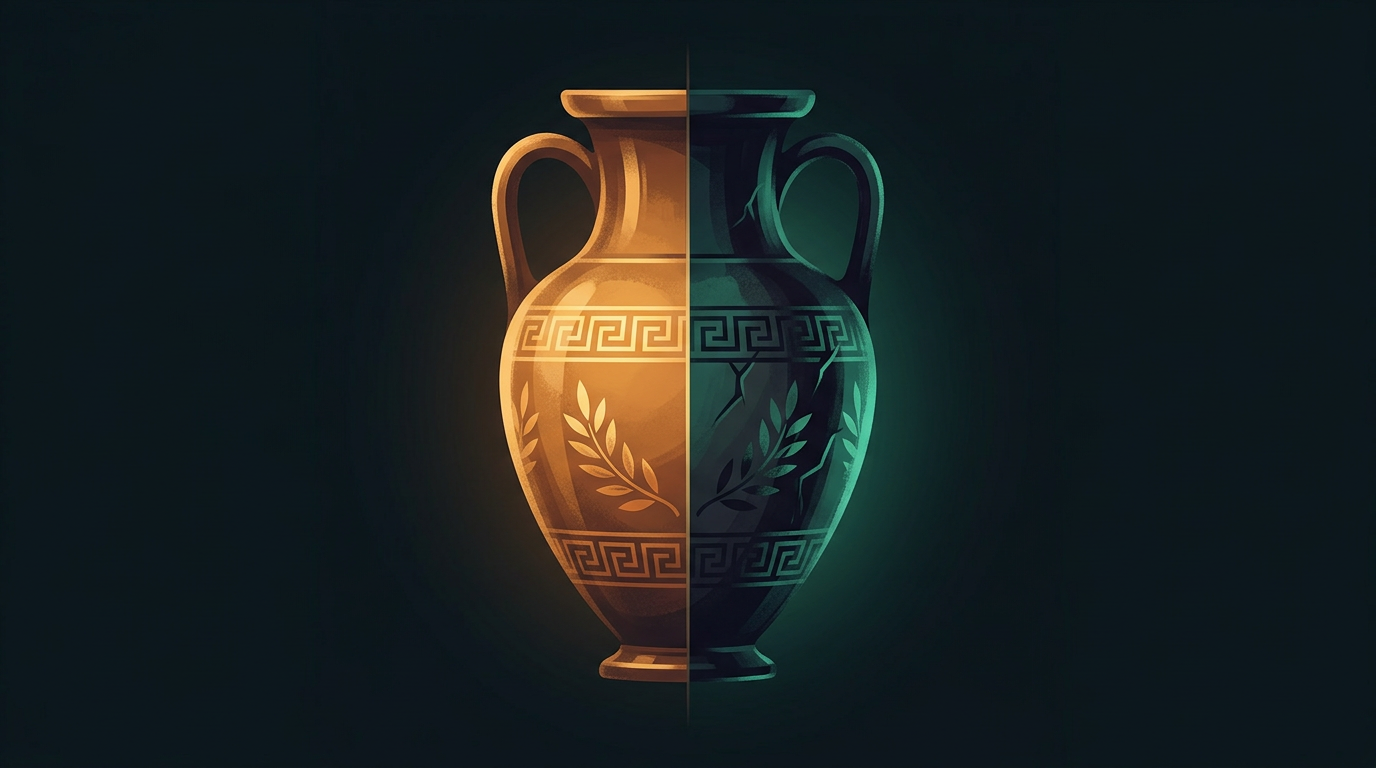
A pharmakon is something whose nature is not fixed. It depends on how it is used, who controls it, and over what time horizon you observe it. This idea runs from ancient philosophy to modern technology—and it gives us a more honest frame for product design, platform governance, and the tools that reshape attention and cognition.
The Ancient Insight: Ambiguity at the Core
In ancient Greek, pharmakon referred to substances like drugs or potions—things that could heal or kill depending on dosage and context (Wikipedia). This wasn’t metaphorical. It was a recognition that:
The same intervention can produce opposite effects depending on how it interacts with a system.
That’s already more sophisticated than the way we often talk about technology: as either “good” or “bad,” or as a tradeoff we can neatly balance.
Plato’s Warning: Writing as a Pharmakon
In the Phaedrus, Plato (through Socrates) calls writing a pharmakon. In the Myth of Theuth, the god Theuth presents writing to King Thamus as “an elixir of memory and wisdom.” Thamus rejects it: writing will produce forgetfulness, not memory—people will trust “external characters which are no part of themselves” and stop exercising their own recall. Writing is a pharmakon of reminding, not memory; it offers “the appearance of wisdom, not true wisdom” (Phaedrus 274c–277a).
So writing doesn’t just store knowledge—it changes how humans think. It externalizes memory. And once you externalize a capability, something subtle happens:
You extend a capability, but you also begin to lose it.
That’s one of the first clear articulations of a pattern we’re still living through: every technology that augments us also displaces something.
Derrida: The Collapse of “Good vs Bad”
Jacques Derrida revisits pharmakon in “Plato’s Pharmacy” (in Dissemination). He argues that the term is fundamentally undecidable. You can’t cleanly categorize it as remedy or poison because its meaning shifts with context and interpretation. Favoring one sense over the other “does interpretive violence to what would otherwise remain undecidable.” The pharmakon’s “unity precedes the opposition between different effects” (Wikipedia, Pharmakon; Kakoliris, “The Undecidable Pharmakon”).
This isn’t just wordplay. It’s structural:
Some things are inherently ambiguous—not because we lack clarity, but because they resist simplification.
Technology is one of those things.
The Hidden Layer: The Pharmakos (Scapegoat)
A related term is φαρμακός (pharmakos)—a ritual scapegoat. In ancient Greek practice (e.g. at the Thargelia in Athens), a person could be expelled or sacrificed to purify the community. They were both the source of pollution and the means of cleansing (Wikipedia, Pharmakos). That reveals something systemic:
Systems often push their problems onto something else to restore balance.
Sound familiar? Content moderation teams absorbing platform toxicity. Gig workers absorbing operational risk. Users absorbing cognitive overload from “free” products. The pharmakon isn’t only chemical or conceptual—it’s structural. The “cure” for one part of the system can be the “poison” for another.
Modern Pharmaka: Technology as Intervention
Look at modern technology through this lens.
Social media: Cure—connection, expression, global communication. Poison—addiction, fragmentation, attention erosion. It didn’t just connect people; it restructured attention as a commodity. Bernard Stiegler and others have analyzed digital technology as a pharmakon of attention: it can “give birth to new attentional forms” or exhaust them (Wikipedia, citing Stiegler).
AI: Cure—cognitive amplification, automation, creativity. Poison—deskilling, over-reliance, loss of epistemic grounding. It helps you think—but it may also change what it means to think.
Blockchain / decentralized systems: Cure—reduced single-point trust, censorship resistance. Poison—complexity, fragmentation, speculative instability. It removes some centralized trust while introducing new forms of opaque dependency.
Surveillance systems: Cure—safety, coordination, visibility. Poison—control, loss of privacy, behavioral manipulation.
A General Law Emerges
If you zoom out, a pattern appears:
The more powerful a technology is, the more pharmacological it becomes.
Or more precisely: Every meaningful technology is a pharmakon—it solves a problem by creating a new one. Not accidentally. Structurally.
The Real Mechanism: Displacement and Dependency
What’s actually happening under the hood? Every technology does at least three things:
- It displaces a human capability (memory → writing, navigation → GPS, reasoning → AI).
- It creates a dependency (you now rely on the system to function).
- It shifts where failure happens (less visible day-to-day, more catastrophic when it breaks).
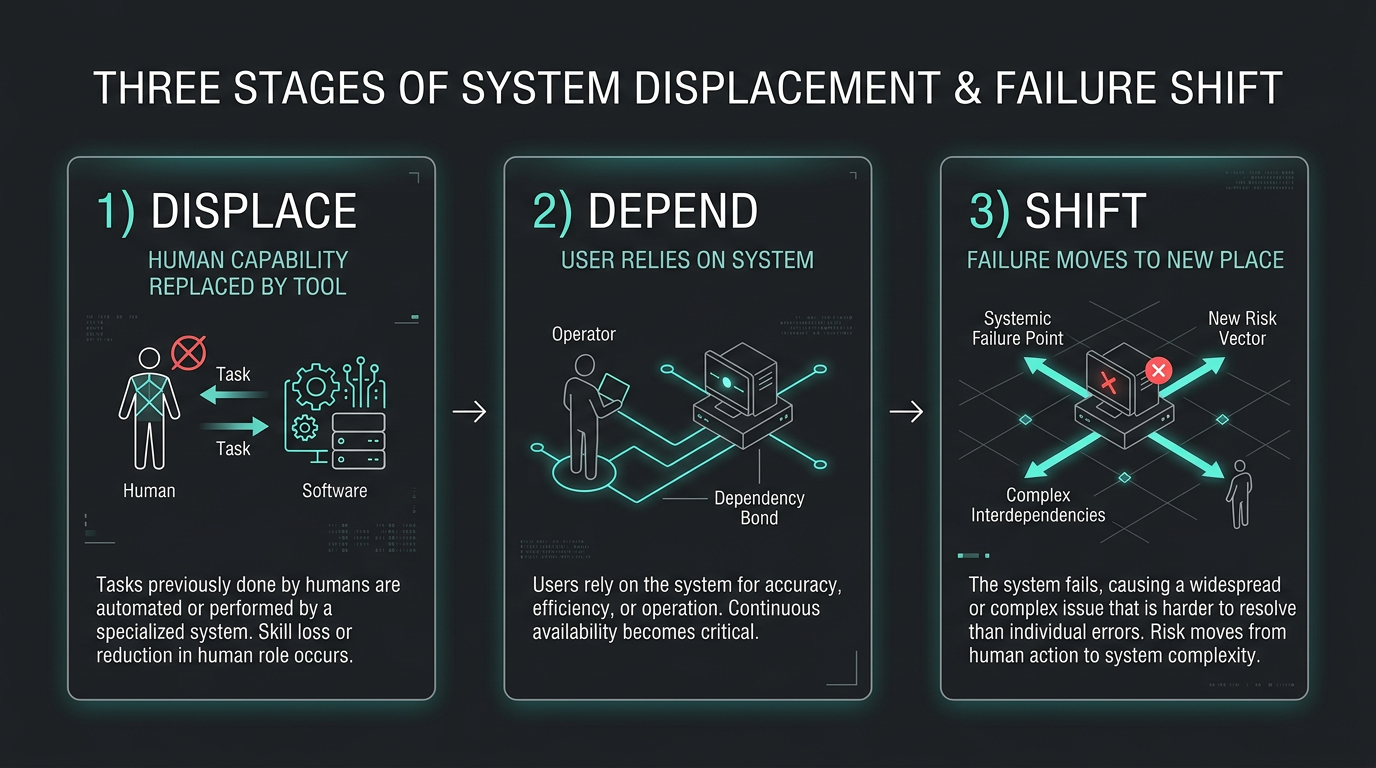
The cure and the poison are not separate—they are entangled. Stiegler’s point is apt: externalized support (writing, digital tools) is the condition of much of our creative and intellectual life—but it is also what makes us vulnerable to new forms of control and atrophy (Stiegler, What Makes Life Worth Living: On Pharmacology).
The Missing Question in Product Design
Most product thinking asks: “Does this feature provide value?” That’s incomplete. A pharmakon-aware question set is:
- What does this replace?
- What does it make users dependent on?
- What becomes weaker over time?
- Where does the hidden cost go?
- What happens when this scales 10×?
The danger isn’t usually in the initial use—it’s in saturation. Dosage and context turn the same intervention from remedy into poison.
The Future: Meta-Pharmaka
We’re entering a new phase. AI copilots, brain–computer interfaces, digital twins—these aren’t just tools. They are systems that modify the conditions of human cognition itself. They are pharmaka acting on other pharmaka. Second-order interventions. So:
The stakes are no longer just behavioral—they are cognitive and existential.
Designing With Pharmacological Awareness
The goal isn’t to avoid pharmaka. That’s impossible. The goal is to design with awareness of them. A well-designed system is not one that has no downside. It’s one where the benefits are real, the risks are visible, the usage is bounded, the dependencies are understood, and the failure modes are survivable.
A good product doesn’t eliminate the poison—it controls the dosage.
Closing Thought
The Greeks understood something we’re rediscovering: the most powerful forces in a system are not purely good or bad—they are transformative. Fire, writing, medicine, AI—these are all pharmaka. The question isn’t whether they will change us. The question is:
Do we understand how they are changing us while we still have the ability to shape them?
Sources & Further Reading
Pharmakon & Plato
- Pharmakon (Wikipedia) — critical theory, Derrida, Stiegler, pharmacology.
- Plato, Phaedrus 274c–277a (Perseus) — Myth of Theuth, writing as pharmakon.
- Derrida, Jacques. “Plato’s Pharmacy.” In Dissemination, trans. Barbara Johnson. Chicago: University of Chicago Press, 1981.
Pharmakos (Ritual Scapegoat)
- Pharmakos (Wikipedia) — Thargelia, purification, Girard.
- Pharmakos (Oxford Classical Dictionary).
Technology & Pharmacology
- Stiegler, Bernard. What Makes Life Worth Living: On Pharmacology. Cambridge: Polity, 2010.
- Stiegler, Bernard. “Relational ecology and the digital pharmakon.” Culture Machine 13 (2012).
- Philosophy of technology (Wikipedia).