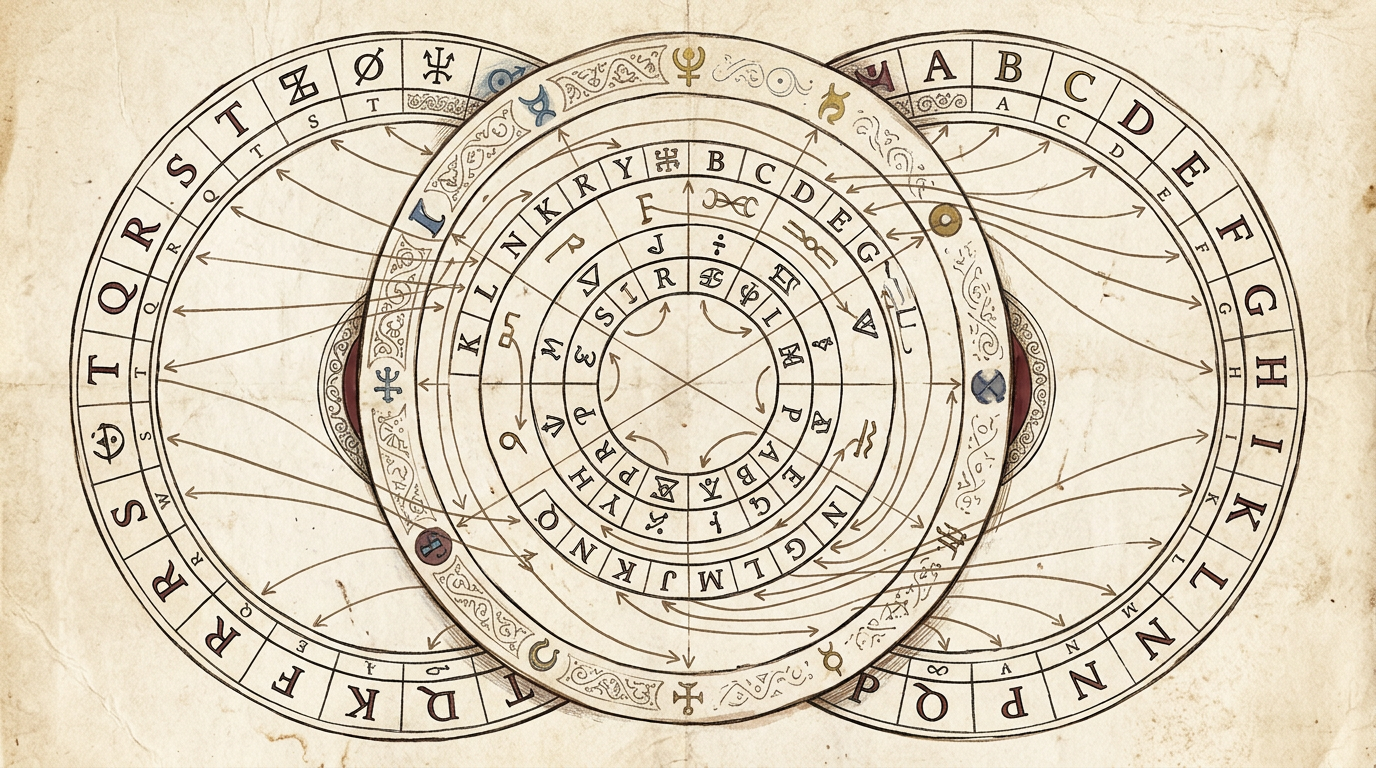
At the center of Llull’s metaphysics is the claim that the world reflects God’s attributes. He used the Ars magna to relate theology, philosophy, and the natural sciences as analogues of one another and as manifestations of the divine in the universe (Encyclopedia Britannica). The basic terms of the Ars are “Dignities”—Goodness, Greatness, Eternity, Wisdom, Power, Truth, and the like—divine perfections that in God exist supremely and whose interrelations ground the intelligibility of reality (Stanford Encyclopedia of Philosophy).
That metaphysical starting point is inseparable from his religious project. Llull’s aim was not neutral philosophy in the modern sense. He wanted a rational method that could defend Christianity and persuade Jews and Muslims without depending merely on authority or proof-texting. The SEP notes that he structured the Ars not around specifically Christian dogmas like the Trinity or Incarnation, but around principles he thought the Abrahamic religions could share, so that debate could proceed on common ground. The “machine” was designed as a universal disputation engine: start from shared first principles, combine them rigorously, and let truth emerge through lawful relations among them.
His spirituality also matters. Llull’s conversion and later project were shaped by visions of Christ and, according to tradition, by an experience on Mount Randa in which he perceived the universe as reflecting divine attributes. His work is permeated by philosophical, religious, and political convictions; the tradition holds that on Randa he conceived reducing all knowledge to first principles and finding their unity. So his combinatorial system is not just logical formalism—it is the attempt to translate mystical insight into an operational method. He saw contemplation and rational procedure as allies.
The Machine as Calculator of Relations
The machine is not primarily a calculator of numbers. It is a calculator of relations among principles. In the Ars, terms, figures, and an alphabet are arranged so that the user can systematically generate questions, combinations, and arguments. The figures are circles, tables, and triangles; the alphabet uses letters as placeholders for terms; answers are combinations formed from these elements. In some versions the figures are explicitly rotational, making the combinatorial character of the method visible (SEP; The Art of Reasoning in Medieval Manuscripts).
The key conceptual move: Llull assumes that if the basic principles are true and universally valid, then their lawful combinations can disclose further truths. The Art of Reasoning site describes the system as a logical machine in which basic statements accepted as true can be used to calculate derivative statements and possible solutions. The Ars is a system for accessing logical and metaphysical truth, finding novel arguments, and generating knowledge, while still serving missionary and moral purposes (art-of-reasoning.huygens.knaw.nl).
Four Deep Assumptions
The machine rests on several deep assumptions.
First, reality is structurally intelligible. Truth is not random. The universe is ordered because it is grounded in divine attributes.
Second, basic concepts are generative. A finite set of principles can produce a much larger space of valid judgments when properly combined. Llull’s figures literally encode this generativity; the connected lines and rotating letters embody a search through conceptual possibility space.
Third, reason can be externalized into procedure. Instead of leaving thought entirely to intuition, rhetoric, or memory, Llull tries to give it a repeatable form. The result is not modern formal logic, but it is undeniably procedural.
Fourth, knowledge is unified. Theology, philosophy, ethics, and nature are not sealed compartments; they can be traversed through the same underlying principles because all reflect the same source.
Why Llull Matters for the History of Computing
He did not invent computer science, and there is no direct uninterrupted line from Mallorca in the thirteenth century to modern software. But he did articulate one of the most important preconditions of computability: the belief that reasoning can be rendered into manipulable symbols and systematic operations. That is why later thinkers found him provocative (The Public Domain Review).
Leibniz encountered Llull through later intellectual circles and was especially struck by two ideas: that complex thought might be reduced to fundamental elements, and that one might calculate with those elements by a method of combination. That connects to Leibniz’s dream of an “alphabet of human thought” and a universal language in which disputes could be settled by calculation (Public Domain Review).
Llull does not anticipate binary arithmetic or Turing machines in any strict technical sense. The stronger claim is subtler: he belongs to the genealogy of the computational imagination. He helped establish the possibility that thought itself could be symbolized, decomposed, recombined, and mechanically guided. That aspiration later appears in Leibniz’s combinatorial art, in formal logic, in symbolic AI, and in computer science.
What Traveled Forward
An alphabet of primitives. Llull’s dignities and principles function like a basis set. Modern logic, programming languages, and knowledge representation all depend on defining a limited vocabulary of primitives and rules for composition.
Combinatorial generation. Llull’s diagrams systematically produce pairings and higher-order combinations. In modern terms, that is a search procedure over a symbolic space—central to theorem proving, programming, symbolic AI, and some uses of large language models.
Proceduralized reasoning. Users follow figures, rules, and question schemes rather than only free-form dialectic. The instinct to turn inference into an executable method is foundational for algorithms.
Unification through representation. Llull thought diverse domains could be navigated through one underlying symbolic system. Modern computer science does something analogous whenever text, images, logic, and physical processes are represented in machine-processable form.
Cautionary Insights
Llull’s system was powerful because it was rooted in a rich metaphysical vision, but limited by that same fact. His principles were not empirically discovered neutral atoms of reason; they were theologically charged categories. His machine could generate arguments, but not by itself guarantee that its primitives were universally accepted, nor that every combination tracked reality. Modern computer science formalized syntax and semantics more strictly, but it still faces an analogous issue: every reasoning system inherits the assumptions baked into its primitives, ontologies, and training data.
Every thinking machine is a frozen metaphysics. Llull’s machine encoded a Christian-Neoplatonic cosmos. Modern computers encode mathematical formalism, engineering tradeoffs, and human institutional choices. Neither is worldview-free. The difference is that Llull made his assumptions explicit—Goodness, Truth, Wisdom, Power—whereas our systems often hide theirs behind technical abstraction.
A second durable insight: computation begins before electronics. The deepest origin of computer science is not the silicon chip but the attempt to make reasoning explicit, discrete, reproducible, and compositional.
A third: symbolic systems are strongest when paired with a philosophy of meaning. Llull’s machine was not just syntax; it was syntax anchored to ontology and purpose. Modern AI often has the opposite problem: enormous procedural capacity with unstable grounding.
A fourth: the dream of a universal language of reason is still alive. It shows up in logic, semantic web ontologies, programming languages, proof assistants, knowledge graphs, and AI alignment. Find the right primitives, the right rules of combination, and a system that can mediate disagreement more reliably than rhetoric alone.
Practical Takeaway
The arc: Llull begins with a religious vision of an intelligible cosmos structured by divine attributes; from that he builds a combinatorial art meant to guide argument and discover truth; later thinkers, especially Leibniz, abstract from the theological content and preserve the formal aspiration—an alphabet of thought plus calculable combination; from there the project evolves into symbolic logic, formal languages, and computer science. The lineage is not linear, but the family resemblance is real.
If you want to build a serious “thinking machine,” start where Llull started: decide what your first principles are, what relations among them are admissible, what counts as truth, and what human end the system is for. His machine was primitive by modern standards, but it asked the right architectural questions.
Sources & Further Reading
Primary & Introductory
- Ramon Llull (Encyclopedia Britannica) — life, Ars magna, theology and natural sciences.
- Ramon Llull (Stanford Encyclopedia of Philosophy) — metaphysics, theory of knowledge, Ars magna, figures and alphabet.
- Ramon Llull — The Art of Reasoning in Medieval Manuscripts (Huygens ING) — life in pictures, Ars magna diagrams, manuscripts (Karlsruhe BLB).
Llull, Leibniz & the Computational Imagination
- “Let us Calculate!”: Leibniz, Llull, and the Computational Imagination (The Public Domain Review) — transmission from Llull to Leibniz, alphabet of thought, universal language.
Further Scholarship
- Ramon Llull (Wikipedia) — overview and references.
- Fidora, A. and Rubio (eds.), Raimundus Lullus: An Introduction to His Life, Works and Thought. Brepols, 2008.
- Digitisation and bibliography of the Breviculum manuscript: Badische Landesbibliothek Karlsruhe, St. Peter perg. 92.