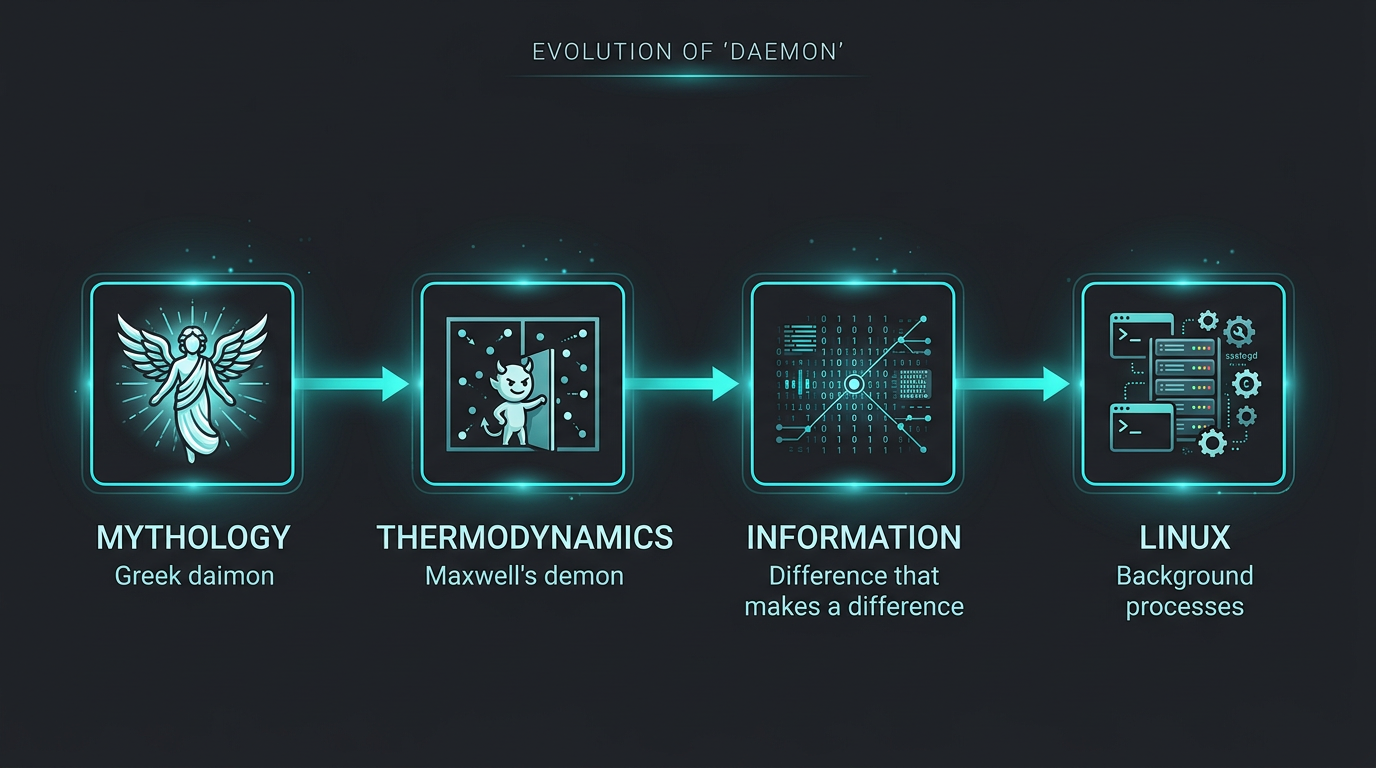
If you run ps aux on a Linux system, you will see dozens of mysterious processes running in the background: systemd, sshd, cron, dbus-daemon, journald. These are called daemons. They rarely appear on the screen; they work quietly in the background. Yet they maintain the stability and structure of the entire system.
The surprising thing is that the word daemon carries a lineage stretching across three thousand years of human thought. It begins in ancient mythology, travels through thermodynamics, evolves into information theory, and eventually lands inside Unix architecture. Following that lineage reveals something profound:
A daemon is an agent that converts information into order.
1. Mythology: The Greek Daimon
The term daemon comes from the Greek word δαίμων (daimōn). In ancient Greek thought, a daimon was not an evil entity. Instead, it referred to a spirit or intermediary power operating between gods and humans (Wikipedia).
Plato described daimons as beings that:
- carry messages between divine and human realms
- interpret actions and intentions
- mediate forces within the cosmos
In other words: Daimons were invisible agents that maintained structure and communication in the universe. They were rarely seen directly. People inferred their presence from their effects. Events occurred; destiny unfolded; order was preserved. And the explanation was often: A daimon was at work.
Even Socrates famously described a daimonion, an inner guiding voice warning him against mistakes. The key idea: A daimon was an unseen mediator that maintained order between systems.
2. Thermodynamics: Maxwell’s Demon
Fast-forward to 1867. Physicist James Clerk Maxwell proposed a famous thought experiment. Imagine a tiny being controlling a door between two chambers of gas. The creature observes individual molecules:
- When a fast molecule approaches → open the door
- When a slow molecule approaches → close the door
Over time, fast molecules accumulate on one side and slow ones on the other. This would appear to create a temperature difference without performing work, seemingly violating the Second Law of Thermodynamics. This hypothetical creature became known as Maxwell’s Demon.
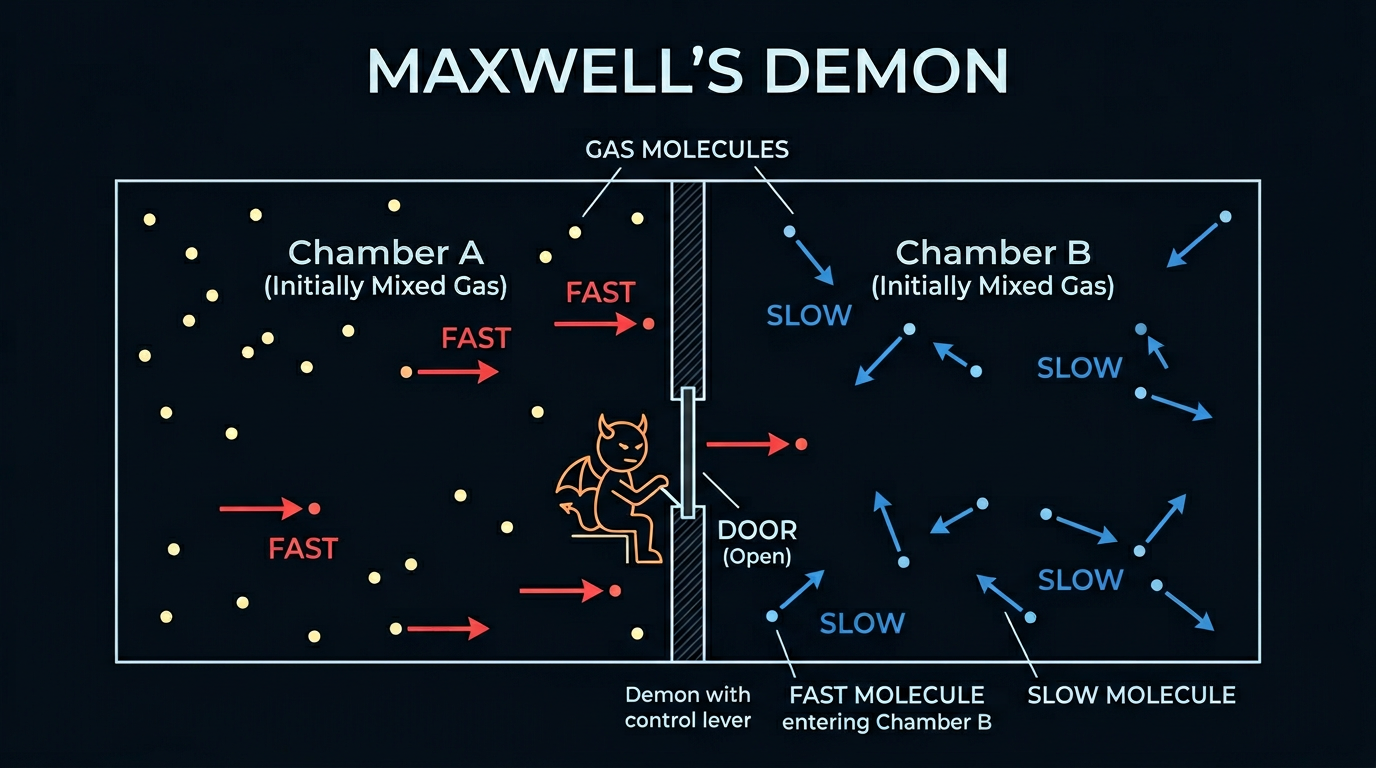
The critical insight was not the violation of physics. The insight was that the demon must possess information. It must know which molecules are fast, which are slow, and when to open the gate. In modern thermodynamics this paradox was resolved by recognizing that information processing has physical cost. The demon can create order only because it processes information about the system (arXiv).
This realization forged a deep connection between information and entropy. Order does not appear magically. It appears when a system observes differences and acts on them.
3. Information Theory: Difference That Makes a Difference
In the 20th century, Claude Shannon formalized information theory. Information became quantifiable. But an essential insight remained: information is not simply stored data. Information is distinction. Something becomes informative when it signals that the world is not what we expected.
Examples:
- a packet arrives on a network socket
- a file changes timestamp
- a process exits
- a temperature crosses a threshold
Each event represents a difference in state. Systems remain stable only when something observes those differences and reacts. Maxwell’s demon performs exactly that function: (1) observe molecular state, (2) detect difference (fast vs slow), (3) act to produce order. Modern physics now describes similar systems as information engines, where feedback based on measured information can extract useful work (arXiv).
Information becomes meaningful only when an agent uses it to change the state of a system.
4. Unix Architecture: The Daemon Appears
In the 1960s, programmers at MIT Project MAC needed a term for background service processes. They chose daemon. The name was inspired by Maxwell’s demon, an imaginary being that continually works in the background sorting molecules (Wikipedia). Unix later adopted the same terminology.
A daemon is now defined as a long-running background process that performs system tasks or provides services to other programs (profoundqa.com). Examples:
| Daemon | Purpose |
|---|---|
systemd | maintains system services |
sshd | handles remote login connections |
cron | executes scheduled tasks |
journald | records system logs |
These programs continuously: (1) monitor system state, (2) detect events, (3) trigger actions. Just like Maxwell’s demon observing molecules—just like a daimon mediating cosmic forces.
5. A Society of Invisible Agents
This perspective reveals something important about operating systems. The visible parts of a system—shells, applications, windows—are only the surface layer. Underneath lies a network of background processes quietly maintaining order. They watch sockets, restart failed services, schedule tasks, collect logs, manage authentication, coordinate resources. Without them, the system would collapse into disorder.
A modern operating system is a society of invisible agents maintaining dynamic equilibrium.
6. The Universal Pattern
Once you recognize this pattern, it appears everywhere. Biology: immune cells constantly monitor and destroy anomalies. Cities: traffic control systems regulate flow. Economics: automated systems maintain market liquidity. Brains: autonomic processes regulate heartbeat and breathing. Complex systems are not static structures. They are dynamic processes maintained by agents that monitor and respond to information. Those agents are essentially daemons.
7. Information Becomes Order
At the deepest level, the lineage becomes clear. Ancient myth imagined invisible beings maintaining cosmic balance. Physics imagined a demon converting information into thermodynamic structure. Computer science implemented daemons converting system events into stable operation. Different language—same pattern.
- Mythology: daimons maintain cosmic order.
- Thermodynamics: demons sort molecules using information.
- Information theory: agents detect and act on differences.
- Linux: daemons maintain computational equilibrium.
8. The Quiet Intelligence of Infrastructure
Perhaps the most interesting aspect of daemons is that when they work perfectly, you never notice them. The most important parts of a system are often invisible. Infrastructure is successful precisely when it disappears from awareness. The moment a daemon fails, chaos appears: services crash, network connections fail, tasks stop executing, logs vanish. Suddenly we remember the hidden architecture sustaining everything.
Final Thought
Next time you type ps aux, look at the list differently. You are not just seeing processes. You are observing a distributed ecology of informational agents quietly maintaining order inside a computational universe. Tiny Maxwell demons. Ancient daimons reborn as software. Watching. Waiting. Ready to convert the next small piece of information into stability.
The myth never vanished. It simply became Linux architecture.
Further Reading
Mythology & Philosophy
Maxwell’s Demon & Information Thermodynamics
- Large work extraction and the Landauer limit (arXiv)
- arXiv:1210.5661
- Large deviation analysis of a simple information engine (arXiv)