Game · Original design
From “I can’t focus” to “Play the beta”
This Friday I couldn’t stop thinking about a fast abstract duel with as many game states as possible, as few pieces as possible, and no blown-up mechanics. By 5 PM I started building. Here’s Glyph Grid.
I had this idea for a pure strategy game: quick 10-minute max games, as many possible game states as possible to keep it interesting, as few pieces as possible, and complex strategy without the core mechanics blowing up into chaos. I couldn’t stop daydreaming about it during work.
As soon as 5 PM hit, I got to work. Two full nights and two full days later, I’m happy to introduce Glyph Grid—playable in beta online now. I’m already thinking about new modes, pieces, glyphs, and board sizes. But first: what it is, where it came from, and how to play.
The lore: artifact of non-human origin
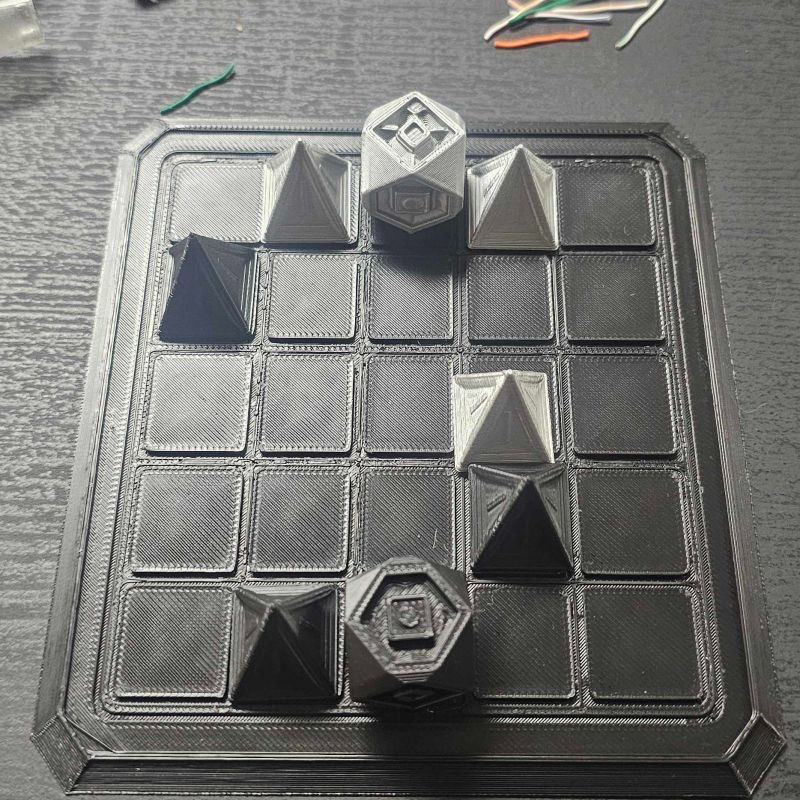
The fiction behind the game is simple: “This game was recovered from an artifact of non-human origin. The glyphs are fragments of an intelligence. Each duel activates the structure.” No long cutscenes—just enough to give the board and the glyphs a bit of weight. Enigmatic, ancient-alien themed. The design (and a real-world travel-set prototype) leans into that: my good friend Phoenix has been exploring a physical version with electromagnets to bring Glyph Grid into the real world while keeping that enigmatic, artifact feel. Shout out to Phoenix for that.
The basics: 5×5 board, Cores, Shards, Glyphs
You play on a 5×5 board. Each player has:
- 1 Core — Your central piece. It can capture enemy Shards and the enemy Core by moving onto them. Losing your Core loses the game.
- 3 Shards — Supporting pieces. They can’t capture other Shards directly; they can push with one of the glyphs (Pulse) and can capture the enemy Core by moving onto it.
So: 2 Cores (one per player), 6 Shards (three per player), and 5 Glyphs that rotate in a shared pool. At the start, each player holds 2 glyphs and 1 glyph sits in the center. On your turn you pick one of your glyphs, pick one of your pieces, and execute that glyph’s move. When you use a glyph, it goes to your opponent and you receive the center glyph. That shared economy is the heart of the game: you’re always planning around what you’ll have next and what your opponent will get.
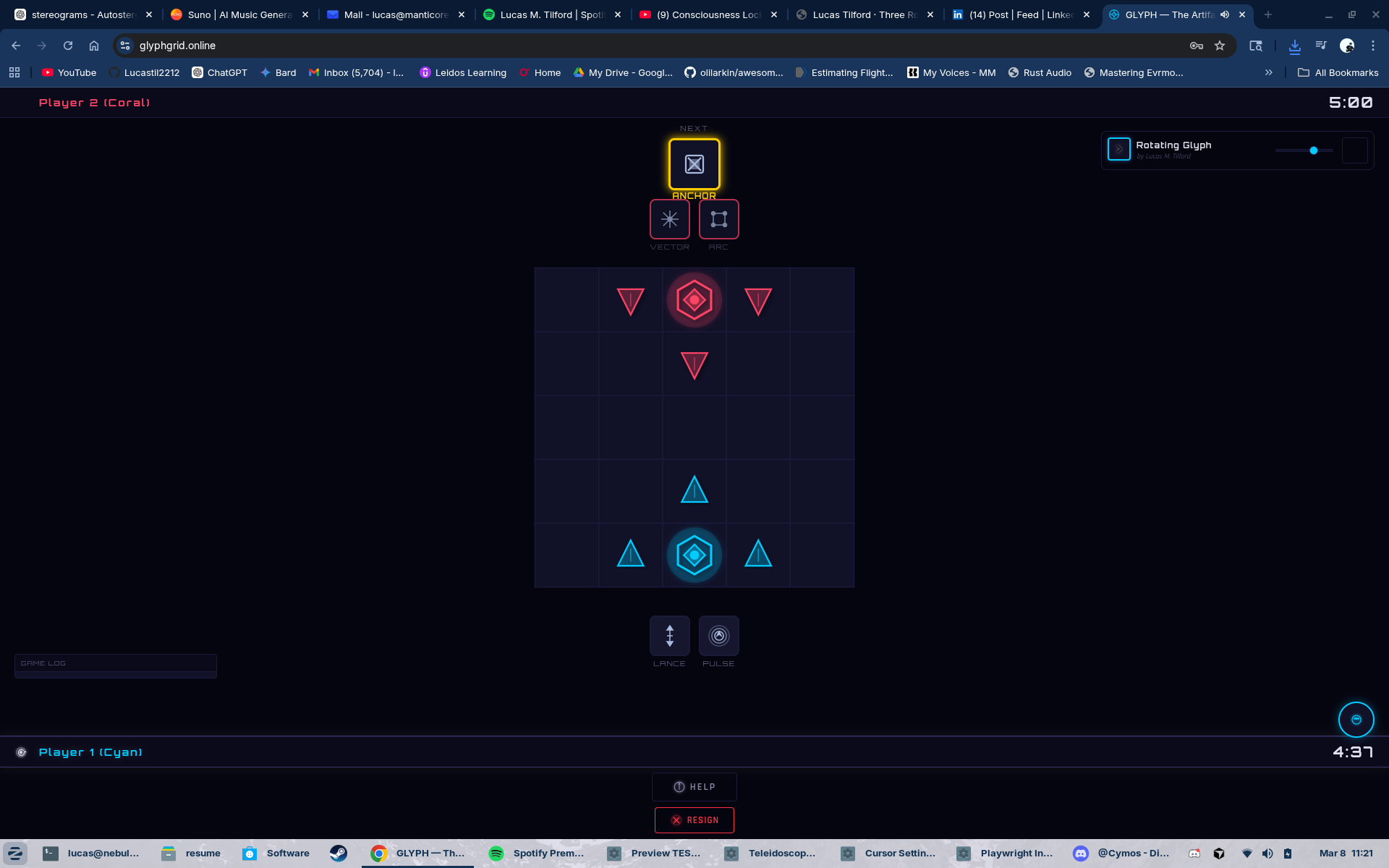
The five Glyphs (and what they do)
Each glyph defines a different way to move or act. The game uses clean geometric SVG icons for each; here’s what they mean:
- VECTOR — Move 1 step in any direction (orthogonal or diagonal). Like a king in chess.
- LANCE — Move exactly 2 spaces in a straight line. Cannot jump over pieces.
- ARC — Move in an L-shape (2 in one direction, 1 perpendicular). Like a knight.
- PULSE — Move 1 step and push an adjacent enemy 1 space in the same direction. You can capture by pushing them off the board or into an occupied square. Shards cannot use PULSE against the enemy Core.
- ANCHOR — Don’t move, and place a resonance mark on your current tile; or move onto an adjacent unoccupied enemy resonance square and claim it. This is the only way to create new resonance.
So you’re constantly choosing: which glyph, which piece, and how that hands the next glyph to your opponent. Zero randomness—pure skill and tempo.
Resonance and how you win
You start with one resonance mark under your Core. Only the ANCHOR glyph creates new marks. Win by:
- Core capture — Your Core captures the opponent’s Core (by moving onto it, or by surrounding it on four sides, or immobilizing it).
- Resonance line — Form 4 of your resonance marks in a straight line (horizontal, vertical, or diagonal).
- Resonance square — Create a 2×2 square of your resonance marks.
- Resonance Dominion — Control 6 resonance marks total.
Pieces on their own resonance squares can’t be pushed by PULSE (they’re protected). But you can still Pulse enemies standing on your resonance. Enemies can use ANCHOR to claim your unoccupied resonance squares. So you’re defending and attacking on both the piece layer and the resonance layer.
The 3D prototype
Phoenix’s travel-set prototype with electromagnets is about bringing this into the real world—same enigmatic, artifact vibe, playable off-screen. Here’s a shot of that prototype:
Play the beta online
The game is live. Ranked 2-player matches, 5-minute clocks, leaderboard, and no RNG—just you, your opponent, and the glyph rotation.
Play Glyph Grid → glyphgrid.online
Queue up, pick your glyphs, and duel. The board grew an arcade: soccer, sniper, fighter, kart, farm, ink — seventeen ranked titles around this one. Roster and how each engine was programmed: GLYPH Arena.